

Da Vinci
Katherine Chan, Artistic Director
Program
As the Sunflower Turns on Her God
Tim Takach
Minnesota-based composer Timothy Takach weaves together contemporary choral music and mathematics in “As the Sunflower Turns on Her God”. The piece is based on the mathematical concept of Phi, also known as the Golden Ratio, which is purported to be one of the most aesthetically pleasing proportions and is found in living things such as flowers and other plants, as well as many places such as art and architecture. The Golden Ratio is an “irrational” number, meaning that its value extends to an infinite number of decimal places without repeating.
The Fibonacci sequence, which is formed by starting with 1 and adding the previous two numbers in the sequence to determine the next number, can help approximate the Golden Ratio. This is done by dividing a number in the sequence by the number that precedes it. The farther along in the sequence, the closer this number gets to the Golden Ratio; however, being an irrational number, this can never be perfectly reached.
To compose this piece, Takach assigned chords to the first 8 numbers of the Fibonacci sequence. Excluding the repetition of the number 1, this includes 1, 2, 3, 5, 8, 13, 21, 34. The chorus’s text recites Phi in Greek to the 82nd decimal place. These chant-like numbers are accompanied by a solo with the text of the initial question that led to the discovery of the Fibonacci sequence, which sought to predict how many offspring a pair of rabbits would produce.
Time
Jennifer Lucy Cook
American composer Jennifer Lucy Cook moves easily between genres, composing for the stage and screen, choral music, and pop songwriting. In “Time,” Cook delves into the paradoxical, essential and yet ephemeral nature of the meaning of the song’s namesake. “Time,” writes Cook, “is one of those funny human-made concepts that dictate our lives but are fundamentally meaningless if we didn’t all agree to go along with it.” This rhythmic composition leans into contemporary a cappella harmonies and creates texture through repetitive lyrics whose meaning changes as phrases elide together and disappear, evoking humor and poignancy at different turns. Says Cook, “We lose time when we try to keep it, we spend time as we try to save it – and since it insists upon eluding us, we can only notice the fact that time has been winking at us all along…this piece is my way of winking back.”
The Notebooks of Leonardo da Vinci
Jocelyn Hagen
Leonardo da Vinci (1452–1519), perhaps the original “Renaissance man,” made his defining mark on the fields of art, science, and engineering during a time of fertile thought-expansion across Europe. His prolific writing on over 13,000 loose pages and in numerous journals and sketchbooks capture inventions, scientific observations, artistic studies, and philosophical reflections. Collectively known as da Vinci’s notebooks, these papers feature the author’s idiosyncratic “mirror-image” handwriting, as well as meticulous drawings ranging from the literal to the wildly imaginative.
In the spirit of da Vinci’s ingenuity, composer Jocelyn Hagen’s 2019 multimedia work incorporates a novel digital syncing software, invented to expand the boundaries of both visual and aural art. Hagen was first inspired to create a work that centered da Vinci’s ideas in 2016, after viewing the Codex Leicester, a privately-held collection of material from his notebooks. On trying to encompass da Vinci’s work in one symphonic piece, she writes, “There was no way … so my goal became serving the spirit of his work and his curious mind.” To build the music, Hagen selected English translations of texts from da Vinci’s notebooks, setting them to nine movements for choir and orchestra. Visual collaborators Isaac Gale, Joseph Midthun, and Justin Schell created corresponding video projections, made to be played using Ion Concert Media’s video software MUSÈIK. The technology allows the projections to be advanced dynamically—following the conductor’s live tempo, as though the video was another member of the musical ensemble. The result is a rare, organic pairing between the audio and visual components.
The Notebooks of Leonardo da Vinci opens with a solitary flute, appearing to represent da Vinci’s own thoughts as a line of his handwriting scribbles across the screen. As more instruments are introduced, the images from the notebooks expand and shift. Finally, as the visuals rest on a human portrait, the choir sings “O Painter!” A reflection on the overlap between poetry and the work of a painter follows, with an array of da Vinci’s human portraits on screen. The buoyant second movement, performed a capella, introduces knowledge as one of the work’s themes. Like a proverb, da Vinci’s text advises the hearer to ground their work in knowledge, sound theory, and principles, saying that “without this nothing can be done well.”
In the third movement, the pairing of the music and simultaneous video shines, with images and sound mimicking the splashing of water droplets. Hagen describes this movement as a combination of two ideas: da Vinci’s own fascination with water, and the music of one of his Milanese contemporaries and friends, music theorist Franchino Gaffurio. Musical phrases from Gaffurio’s Missa di Carneval are woven into the orchestral music. The choir boldly announces in the a capella fourth movement: “The greatest good of all is knowledge,” and the text considers the importance of facts in dispensing with errors and speculation.
The fifth movement centers around the iconic Vitruvian man, the most famous of da Vinci’s sketches. It owes its name to Vitruvius, an ancient Roman architect who viewed the human body as perfectly proportionate, and whose work profoundly influenced da Vinci. During this movement, you’ll hear the choir singing and reciting some of these “perfect proportions” aloud. At the same time, the Vitruvian man will come to life onscreen as da Vinci’s own sketches of the human body are superimposed atop a live human dancer (Stephen Schroeder).
Entirely instrumental, the sixth movement features another of da Vinci’s most famous sketches: his flying machines. A visionary well ahead of his time, da Vinci invented several of his own gliders while studying what he called “the science of the winds.” Today, we call it aerodynamics. During this movement, da Vinci’s flying machines take center stage, joined by “little musical machines” that Hagen invented “to accompany them.” The seventh movement then turns to the natural world, loved and revered by da Vinci. The movement opens gently, pairing a clarinet solo with da Vinci’s sketches of a bird, flying across a vast landscape. The choir enters gradually, praising the beauty, efficiency, and simplicity of “Nature’s inventions,” far surpassing that of any human invention. Afterward, the eighth movement is performed a cappella, with all voice parts singing just one set of text: “All our knowledge has its origin in our perceptions.” As the choir repeats the text, several of da Vinci’s sketches of the human eye appear onscreen. Together, these words and images remind us to remain open to new perspectives, especially as we seek to discover the truth.
The ninth and final movement of the piece shifts our perspective outward, honing in on the image of the night sky, “scattered” with stars. In the words of da Vinci, though these stars seem “minute” to the human eye, many are in fact much “larger…than the earth with water.” Additionally, the text underscores the all-encompassing power of time, which “destroy[s] and devour[s] all things with the relentless teeth of years.” In a similarly grandiose fashion, Hagen rounds out her composition with exuberant, upbeat scoring that includes sharp dynamic contrast and pizzicato violin (when the instrument’s strings are plucked by finger rather than bow). As the music progresses, you will see da Vinci’s portrait of an old man (rumored to be, in fact, a self-portrait) gradually appear onscreen, filling the night sky. And to conclude, Hagen chooses to leave us with one of the most famous, impactful quotes from da Vinci’s notebooks: “Wisdom is the daughter of experience.
Texts and Translations
As the sunflower Turns on Her God by Tim Takach
ena, stigme, hex, ena, okto,
zephyron, treis, treis, ennea, okto,
okto, hepta, tettara, ennea, okto,
ennea, tettara, okto, tettara, okto,
dyo, zephyron, tettara, pente, okto,
hex, okto, treis, tettara, treis,
hex, pente, hex, treis, okto,
ena, ena, hepta, hepta, dyo,
zephyron, treis, zephyron, ennea, ena,
hepta, ennea, okto, zephyron, pente,
(quintet) hepta, hex, dyo, okto, hex,
dyo, ena, treis, pente, tettara,
(tutti) tettara, okto, hex, dyo, dyo,
hepta, zephyron, pente,
dyo, hex, zephyron,
tettara, hex, dyo, okto, ena,
(okto, ennea, zephyron, dyo, tettara,
tettara, ennea, hepta,)
- decimal equivalent of Phi ( φ)& keep crossing oceans
Quidam posuit unum par cuniculorum in quodam loco,
qui erat undique pariete circumdatus, ut sciret,
quot ex eo paria germinarentur in uno anno.
- Fibonacci (Leonardo of Pisa)
- sung in Greek
A certain person placed one pair of rabbits in a certain place
that was on all sides surrounded by a wall, so that he might learn,
how many pairs would be produced from it in one year.
- trans. Anne Groton
Time by Jennifer Lucy Cook
Time
You can spend it
When you spend it
Then you’re running out of
Time
You can save it
But to save it is to take a little
Time
In a minute
When you’re in it
Can you feel the passing
Time
Is an illusion
There’s confusion
When they tell you now it’s
Time
To get older
Time
To work and
Time to waste and there’s no
Time
Left to hold her
Time
To tell him how you feel
While there’s still
Time
Three two one, eleven thirty
Two AM, then dinner
Time
Now to kill
I said I will, and still
t flies and flies, oh
Time
The Notebooks of Leonardo da Vinci by Jocelyn Hagen
1. Painting and Drawing
O Painter!
A painter is not admirable unless he is universal.
A painting is a poem seen but not heard, a poem is a painting heard but not seen. Hence these two poems, or two paintings, have exchanged the senses by which they pierce the intellect.
2. Practice
Those who are in love with practice without knowledge are like the sailor who gets into a ship without rudder or compass and who never can be certain whither he is going. Practice must always be founded on sound theory, and to this, perspective is the guide and the gateway; and without this nothing can be done well in the matter of drawing.
3. Ripples
Just as a stone flung into the water becomes the center and cause of many circles, and as sound diffuses itself in circles in the air; so any object, placed in the luminous atmosphere, diffuses itself in circles, and fills the surrounding air with infinite images of itself. And is repeated, the whole everywhere, and the whole in every smallest part
4. The Greatest Good
The greatest good of all is knowledge.
Obstacle cannot crush me. Every obstacle yields to stern resolve.
The acquisition of any knowledge is always useful to the intellect, because it will be able to banish the useless things and retain those that are good. For nothing can be either loved or hated unless it is first known.
5. The Vitruvian Man
Vitruvius, the architect, says in his work on architecture that the measurements of the human body are distributed by Nature as follows:
four fingers make one palm,
four palms make one foot,
six palms make one cubit;
four cubits make a man’s height.
These measures he used in his building.
If you open your legs so much as to decrease your height one-fourteenth and spread and raise your arms till your middle fingers touch the level of the top of your head you must know that the centre of the outspread limbs will be in the navel and the space between the legs will be an equilateral triangle.
From the roots of the hair to the bottom of the chin is the tenth of a man’s height;
from the bottom of the chin to the top of his head is one eighth of his height;
from the top of the breast to the top of his head will be one sixth of a man.
From the top of the breast to the roots of the hair will be the seventh part of the whole man.
From the nipples to the top of the head will be the fourth part of a man.
The greatest width of the shoulders
From the elbow
The whole hand
below the knee
The length of a man’s outspread arms is equal to his height.
The face forms a square in itself. The distance from the attachment of one ear to the other is equal to that from the meeting of the eyebrows to the chin, and in a fine face the width of the mouth is equal to the length from the parting of the lips to the bottom of the chin.
The ear is exactly as long as the nose. The ear should be as high as from the bottom of the nose to the top of the eyelid. The space between the eyes is equal to the width of an eye.
6. Invention
7. Nature
Though human ingenuity may make various inventions, it will never devise any inventions more beautiful, nor more simple, nor more to the purpose than Nature does; because in her inventions nothing is wanting, and nothing is superfluous.
Necessity is the teacher and tutor of Nature.
8. Perception
All our knowledge has its origin in our perceptions.
9. Look at the Stars
Oh Time! Consumer of all things; O envious age! Thou dost destroy all things and devour all things with the relentless teeth of years, little by little in a slow death.
If you look at the stars, cutting off the rays, you will see those stars so minute that it would seem as though nothing could be smaller; it is in fact their great distance that is the reason of their diminution, for many of them are very many times larger than the star which is the earth with water. Now reflect what this, our star, must look like at such a distance, and then consider how many stars might be added — both in longitude and latitude — between those stars that are scattered over the darkened sky.
Wisdom is the daughter of experience.
-crafted by Jocelyn Hagen using various public domain English translations from Leonardo da Vinci’s notebook pages
Performers
Katherine Chan | Artistic Director
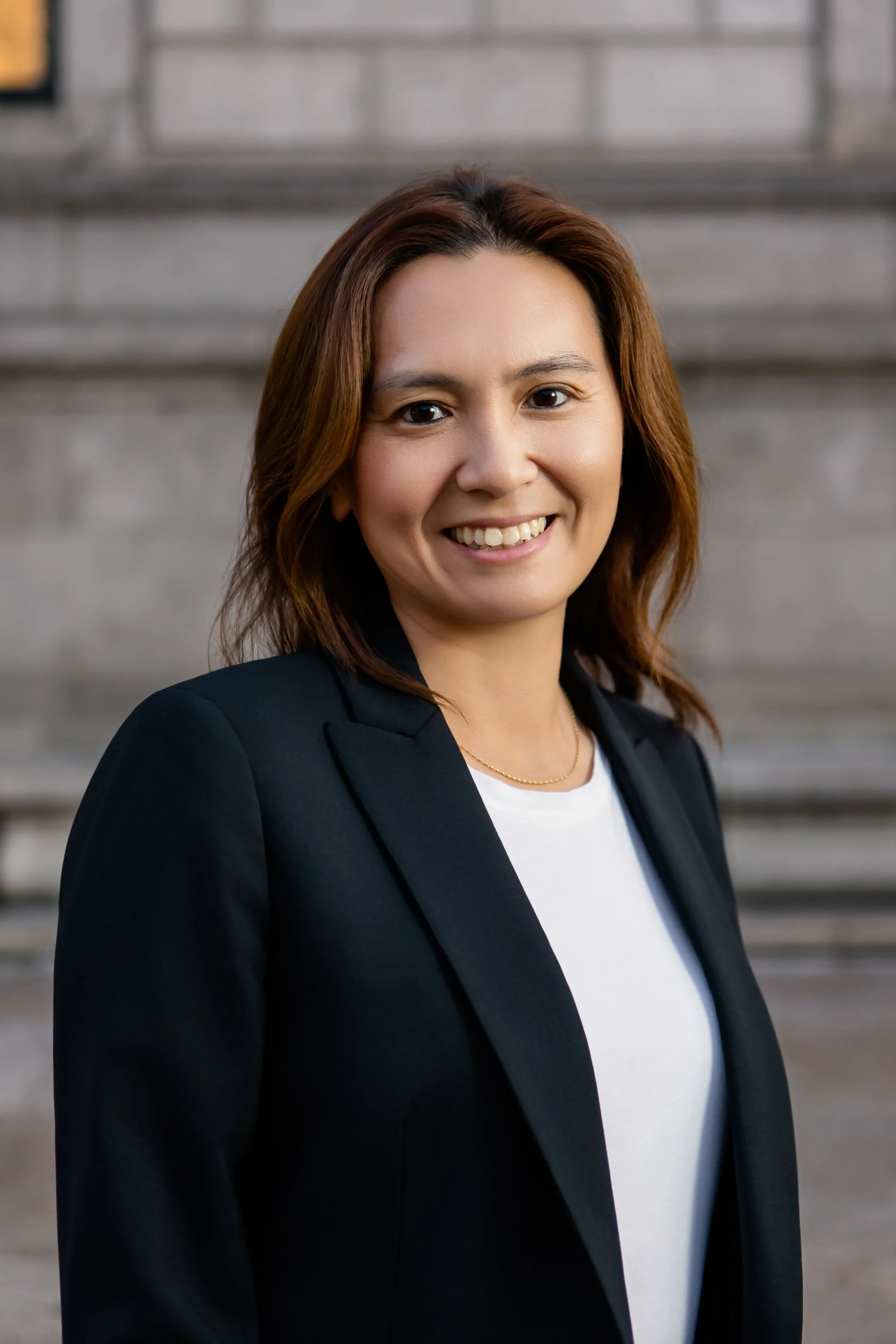
Australian conductor, Katherine Chan, is known for her energy and enthusiasm on the podium. As Director of Choral Activities and Associate Teaching Professor of Music at Northeastern University, Chan conducts the Northeastern University Choral Society & Chamber Singers. A sought-after clinician, Chan also serves as the Artistic Director of Boston Choral Ensemble.
Chan’s unique blend of talent and energy has also been on display at the numerous prestigious international festivals including at Australia National Choral Association (ANCA) Choralfest National Convention, National Conductors’ Symposium, Canada, and American Choral Directors Association (ACDA) National and State Conventions. She has had the privilege of being a conducting scholar with Maestro Helmuth Rilling conducting at Oregon Bach Festival, Taipei Bach Festival and Hong Kong SingFest, and have guest conducted with Minnesota Chorale, Xi’an Symphony Chorus (China), Bach Choir of Bethlehem, Cantata Singers, Boston Landmarks Orchestra, as well as at State and Regional Honor Choir Festivals.
Chan received her Master of Music degree in Choral Conducting from the University of Washington, and Doctor of Musical Arts in Conducting from the University of Minnesota (UMN) under the mentorship of Kathy Saltzman Romey and Matthew Mehaffey.
Jinho Cho | Assistant Conductor
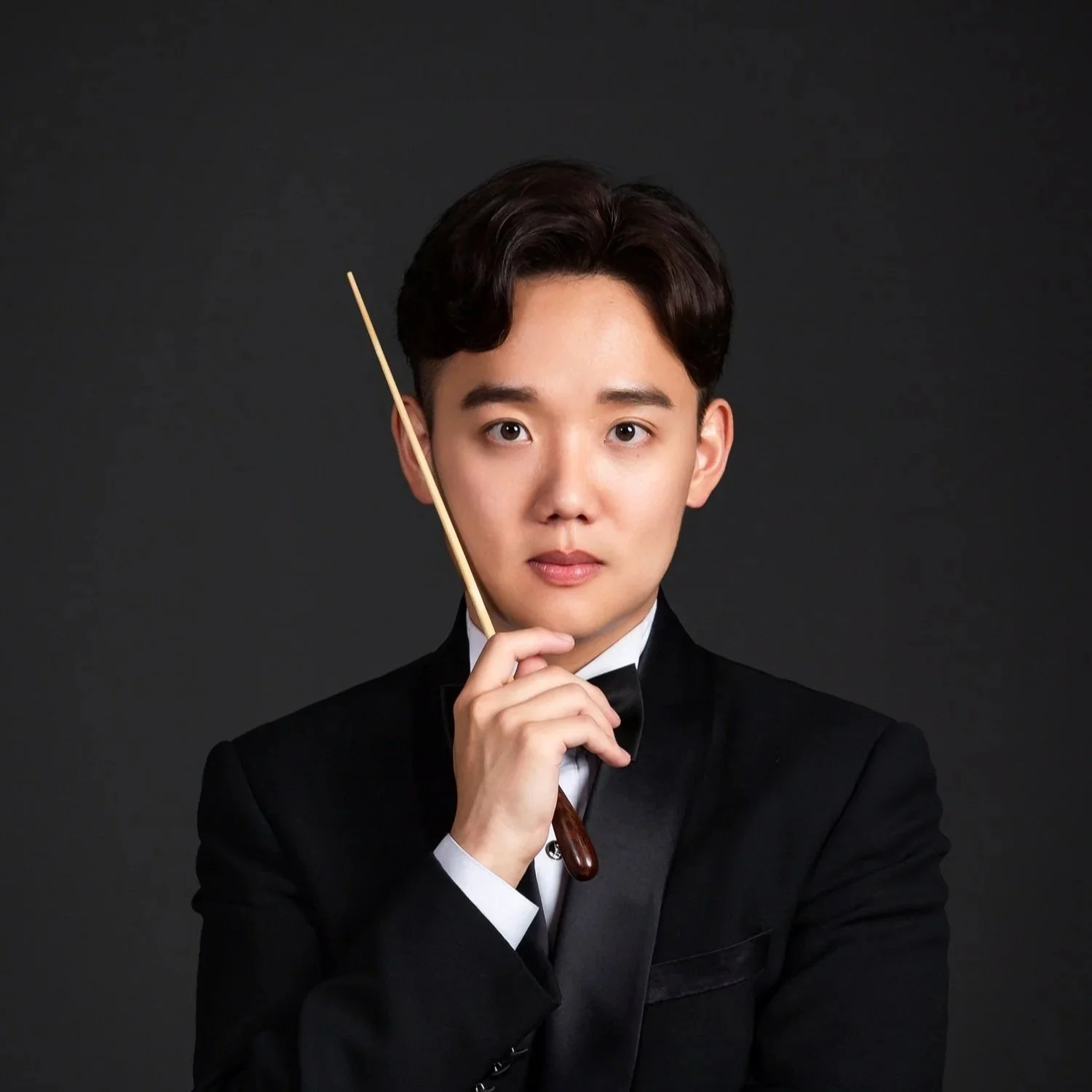
Korean conductor Jinho Cho serves as the Assistant Conductor of the Boston Choral Ensemble and is a DMA Candidate in Choral Conducting at Boston University, studying under Dr. Daniel Parsley and Dr. William Cutter. At BU, he works as a Teaching Assistant for the University Choruses. Cho previously completed his Master of Music in Choral Conducting at The University of Texas at Austin and has led performances of major choral-orchestral works at the Seoul Oratorio Festival. Before beginning his doctoral studies, he worked extensively in classical concert production in Korea, including serving as Planning Team Manager for the 2024 Again Turandot production conducted by Plácido Domingo at COEX, Seoul.
BCE Singers
Sopranos
Elizabeth Garcia
Khye Borg Liew
Kate Melchior
Chrissy Morgan
Lydia Narum
Christa Seid-Graham
Serena Valentin
Elizabeth Wiley
Altos
Joanna Hamilton
Susannah Hatch
Julianna Horiuchi
Joo Hyun Im
Allie Jeffay
Siân Kleindienst
Alexandria Miller
Katherine Miner
Vardit Samuels
Lindsay Sheridan
Tenors
Danny Allin
Trent Buatte
Jinho Cho
Danny Green
Ben Horkley
Bruce Longee
Dan Shaw
Rene Sorina
Joe Veneziano
Chih-Chao Yang
Basses
Will Bingham
Gustavo Cruz
Dylan Griffin
Bryan Hughes
Jeremy Koo
Kevin Madoian
Sam Maurer
Toru Momii
Richard Samuels
Da Vinci Musicians
Violin 1
Lisa Pettipaw
Violin 2
Meghan Titzer
Viola
Stephen Jue
Cello
Jason Coleman
Bass
Dan Gorn
Oboe
Julian Salazar
Flute
Erica Schiller
Clarinet
Tammy Avery-Gibson
Bassoon
George H. Muller
Horn
Paula Limberg
Percussion 1
Sam Schmetterer
Percussion 2
Ryan Chao
Harp
Sorana Scarlat
Video Operator
Chris Haimendorf
Support BCE
Boston Choral Ensemble is a registered 501(c)(3) non-profit organization funded by you, our supporters, and in part by grants from the Massachusetts Cultural Council, and from the Boston Cultural Council, administered by the Mayor’s Office of Arts and Culture.
We are so grateful to those people who have supported us financially. Please consider donating to BCE as part of your end-of-year giving, so we can continue presenting high-quality, accessible choral performances for Boston audiences.
Visit https://www.bostonchoral.org/donate for more information.
This Year’s Sponsors and Donors
Free For All Endowment Fund at the Boston Foundation
Brookline Cultural Council
Cambridge Cultural Council
Eastern Bank Foundation
Katharine Abraham
Matthew Baggetta
Trevor Berg and Mita Lohrasbpour
Nilay Bhatt
Patricia Buckley
Denise and Jeffrey Burns
Rebekah Cochrane
Ellen DeGennaro
Janet Schiff DiFiore
Naomi Feingold
Samantha Fletcher
Tamara Friedler
Karen Friedman-Hanna
Melissa Frontczak
Cheryl C Garcia
Susie Glessner
Joyce Green
Leona Green
Drew Griffin
Dylan Griffin
Marilyn Gustafson
Rachael Haar
Nancy and Raziel Haimi-Cohen
Joanna Hamilton
Michael and Mary Ann Hamilton
Julia Hanna
George and Marina Hatch
Tizzy and Whitney Hatch
Brian Hone
David and Tami Horiuchi
Julianna Horiuchi
Susan Hotchkiss
Diana Hubbard
Allie Jeffay
Gray Karpel
Karen Kelly-Morgan
Grace Kingsbery
Sian Kleindienst
Jeremy Koo
Brianna Larsen
Allyson Lazar
Tori Leonard
Ellen Lidington
Kathleen Lindstrom
Tim Luo
Kelly Lynch
Kimi Macdonald
Samuel Maurer
Julia Mayer
Karla McGuire
Nicole McGuire
Jacob McLennan
Lansing McLoskey
Kate Melchior
Katelyn Miner
Clarissa Modde
Toru Momii
Christine Morgan
Spencer Morgan
Annie Moriondo
Daniel Mulhern
Ngoc Diep Nguyen
Ted Nichols
Martha Person
Sarah Person
Iona, Adam, Alenka, and Kaia Ribaudo
Douglas and Mercer Riis
Lauren Roller
Virginia Rosenberger
Marcia and Edward Samuels
Richard and Vardit Samuels
René Sorina
Eliza Spear
Anna Turk
Diane Venora
Julian Walters
Bruce Weinstein
Jim Wiley
Sam Wiseman